A transmission is more than a collection of individually designed components. The way its gears, bearings, shafts and housing interact under load has a direct influence on how the complete system performs. Understanding those interactions is central to the approach presented in our recent Romax session.
During SIMTEQ Engineering’s Romax Sharpen the Saw session on 16 October 2026, Marceliano Fumero explored how Romax supports transmission development, from early concept layouts through to detailed analysis and optimisation. The discussion focused on three closely connected engineering priorities: durability, noise and vibration, and efficiency.
Why the complete system matters
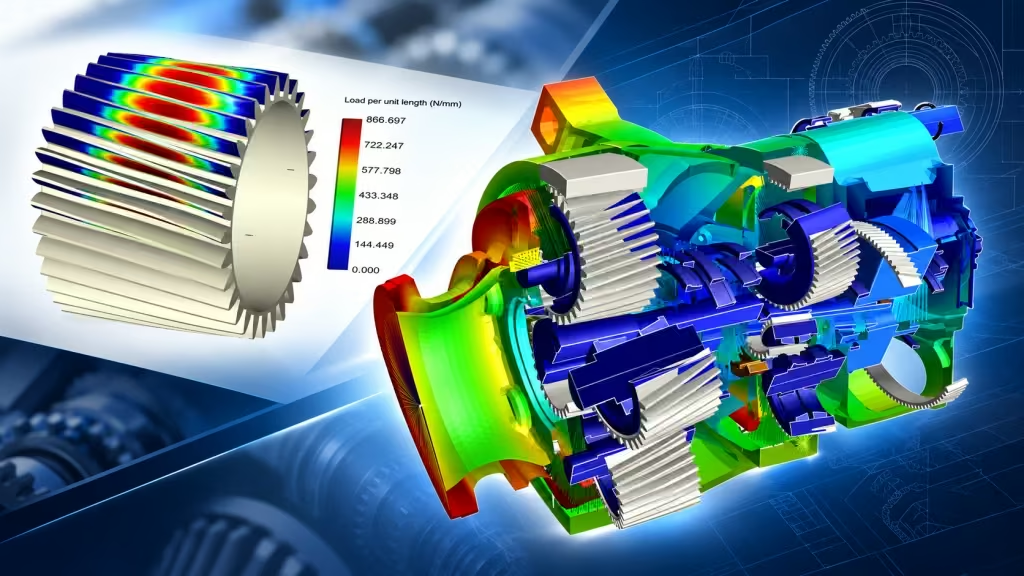
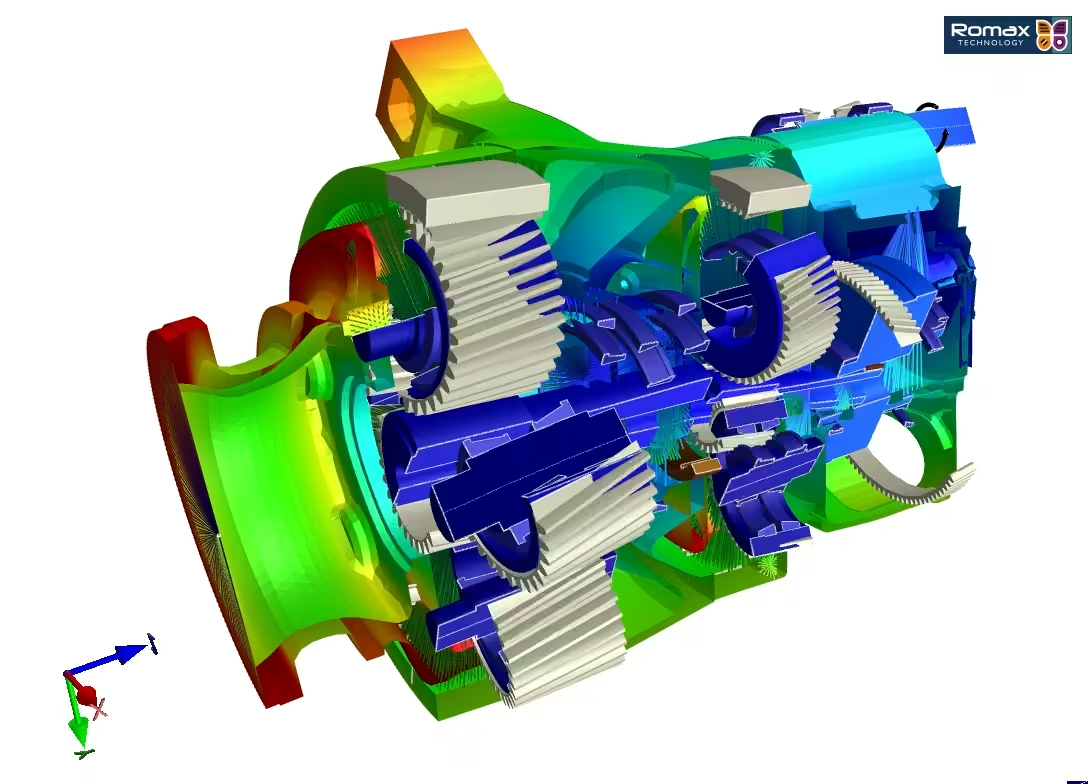
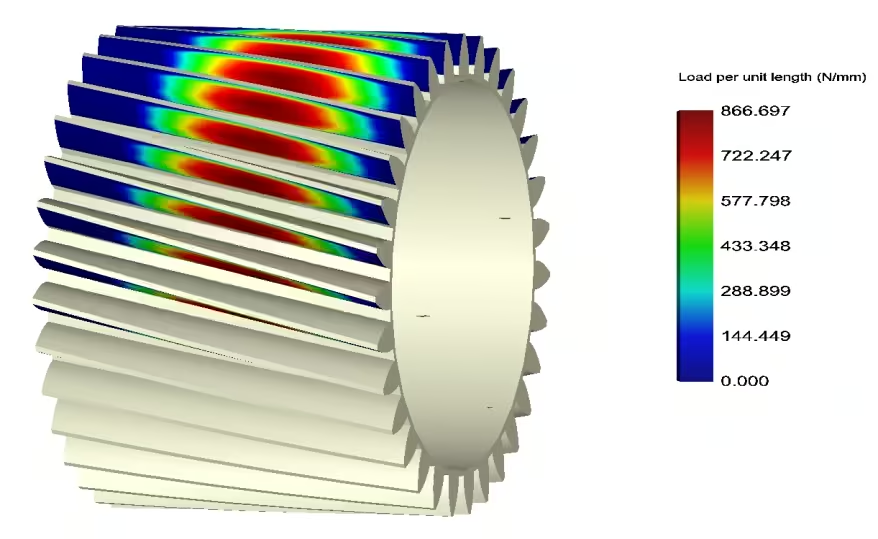
A gear’s performance is influenced by more than its tooth geometry. Shaft deflection and the flexibility of surrounding components can change how the teeth contact each other, concentrating loads across the gear face. Similarly, misalignment between bearing races can alter contact conditions and increase local stresses. A component assessment that overlooks these system effects can therefore miss an important part of the engineering problem.
Romax addresses this by combining finite element representations of components where flexibility matters with analytical contact models for gears and bearings. Rather than relying on a finely meshed contact model for every interaction, this approach brings structural behaviour and detailed contact calculations into the same system model. The aim is to capture the interactions that drive performance without the computational burden of representing every contact using a full finite element model.
Start with a stronger transmission concept
Before refining individual components, engineers need to identify a transmission layout that can meet their requirements.
Romax Concept supports this early development stage by allowing engineers to create layouts, define shafts and gears, establish power flow and compare potential designs. Packaging constraints, shaft centre distances and performance requirements help guide the selection process. Engineers can also explore gear macro-geometry, make preliminary bearing selections and compare early performance estimates.
These concept-stage results are preliminary comparisons, not a substitute for detailed system analysis. As explained during the session, Romax Concept assumes a rigid system rather than accounting for component deflections. Once a promising concept has been identified, the model can progress into detailed analysis, where flexibility and additional component information are introduced.
The presenter illustrated this workflow through a Hyundai example, describing how earlier concept assessment helped the engineering team enter detailed development with greater confidence and encounter fewer problems during subsequent testing.
Improve durability through better load distribution
Durability was a central theme throughout the session. For gears, bearings and simple shafts, the workflow includes standards-based component ratings. For complex components such as housings and planetary carriers, finite element stress analysis provides a complementary assessment.
For gear design, the presentation distinguished between macro-geometry, which describes the main tooth geometry, and micro-geometry, which involves small modifications to the tooth surface to improve the contact pattern. Understanding system loads and deflections helps engineers evaluate these modifications in the conditions the gear will experience, rather than considering its geometry in isolation.
Bearing selection follows the same system-level logic. Catalogue models support the selection process, while parameters such as preload and its response to temperature can be explored as part of the assembly design. Where flexibility becomes significant, for example in large bearing races or lightweight gear blanks, it can also be included in the model.
This approach also supports existing structural analysis workflows. The session described how flexible components and their calculated loading conditions can be exported for further work in tools such as MSC Nastran, allowing local design improvements to be informed by the behaviour of the complete transmission.
Trace noise from the gears to the surrounding environment
A transmission can meet its durability requirements and still produce unacceptable noise.
The session identified transmission error as an important source of gear excitation. Variations associated with tooth engagement, contact stiffness and system deflection can generate vibration that contributes to gear whine. Addressing the problem therefore requires more than inspecting the gearbox housing or treating the sound after it has been generated.
The Romax workflow presented in the session connects the gear excitation to the system’s vibration response and then to its acoustic behaviour. This allows engineers to investigate critical vibration modes and assess how sound radiates from the housing to positions around the transmission using virtual microphones.
For electric drivelines, excitations from the electric motor can also be considered alongside those from the gears. This provides a way to investigate how the two sources interact, rather than treating them as separate problems. The discussion also highlighted the use of integrated models to study how manufacturing variability can influence noise and vibration performance.
Include efficiency in the design discussion
Durability and noise are not the only measures of a successful transmission. Power losses must also be considered.
The session explained how Romax calculates losses in gears and bearings under the specified operating conditions. Much of the model information used for durability and noise analysis also supports efficiency assessment, with additional inputs such as lubrication information where required.
This makes efficiency part of the wider optimisation process. Engineers can assess whether a change intended to improve durability or reduce noise introduces an unwanted efficiency penalty. The presenter’s NBC Bearings example illustrated this balance: bearing geometry was optimised to improve efficiency while maintaining durability performance.
Balance weight, durability, noise and efficiency
One of the clearest messages from the session was that improving one performance measure does not automatically improve the others.
Reducing gearbox mass, for example, can increase structural flexibility and change the contact conditions within gears and bearings. The resulting design needs to be evaluated against its durability and noise requirements, rather than judged on weight reduction alone. This was also discussed during the closing questions about gearbox lightweighting.
A ZF Wind Power example demonstrated this challenge. As presented during the session, the team needed to reduce transmission mass and noise while retaining durability. The work involved evaluating the complete transmission and refining gear geometry and contact conditions to meet the competing requirements.
Romax’s parametric optimisation capabilities support this type of trade-off study. Rather than changing a component and checking only one outcome, engineers can investigate how design parameters affect multiple performance objectives within a connected workflow.
Bring the system into your next design decision
The session demonstrated a progression from comparing concepts to understanding system deflection, refining component design and balancing performance requirements. The value of that approach lies in connecting decisions that might otherwise be made separately.
Working on a transmission, gearbox or electric driveline? Contact SIMTEQ Engineering to discuss how Romax could support your development process.