CradleCFD | Discrete Element Method
From rock transfer chutes to particle-fluid interactions, DEM simulation reveals how granular materials move, collide and behave inside real equipment.
Model contact, collision and motion
Explore particle-fluid interaction
Analyse chutes, hoppers and mixers
UNDERSTANDING GRANULAR MATERIALS
The Discrete Element Method (DEM) represents granular material as individual particles. It calculates their movement and contact forces, rather than treating the entire material as a continuous mass.
With CradleCFD, engineers can investigate how particles collide, accumulate, flow through equipment, and respond to their surroundings.

THE TECHNOLOGY
Particle behaviour depends on geometry, material properties, and the interaction of thousands of contacts. Cradle provides modelling tools to investigate those influences.
Account for particle collisions, restitution, static friction, and rolling resistance to examine how granular material interacts with itself and equipment surfaces.
Use particle size distributions and cluster models to explore how non-uniform granular materials move, segregate and settle in a system.
Explore how cohesive particle contacts may influence agglomeration, consolidation, accumulation and restricted discharge.
SIMUALTION EXAMPLES
Use simulation to reveal flow restrictions, particle trajectories and discharge characteristics that are difficult to observe inside an operating system.
MATERIAL HANDLING
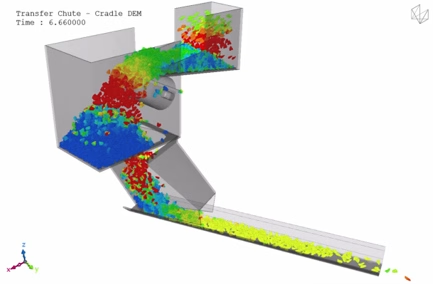
Evaluate trajectories, contact locations and material accumulation as bulk solids move between equipment stages. Compare geometries and operating conditions to understand transfer behaviour.
STORAGE & DISCHARGE
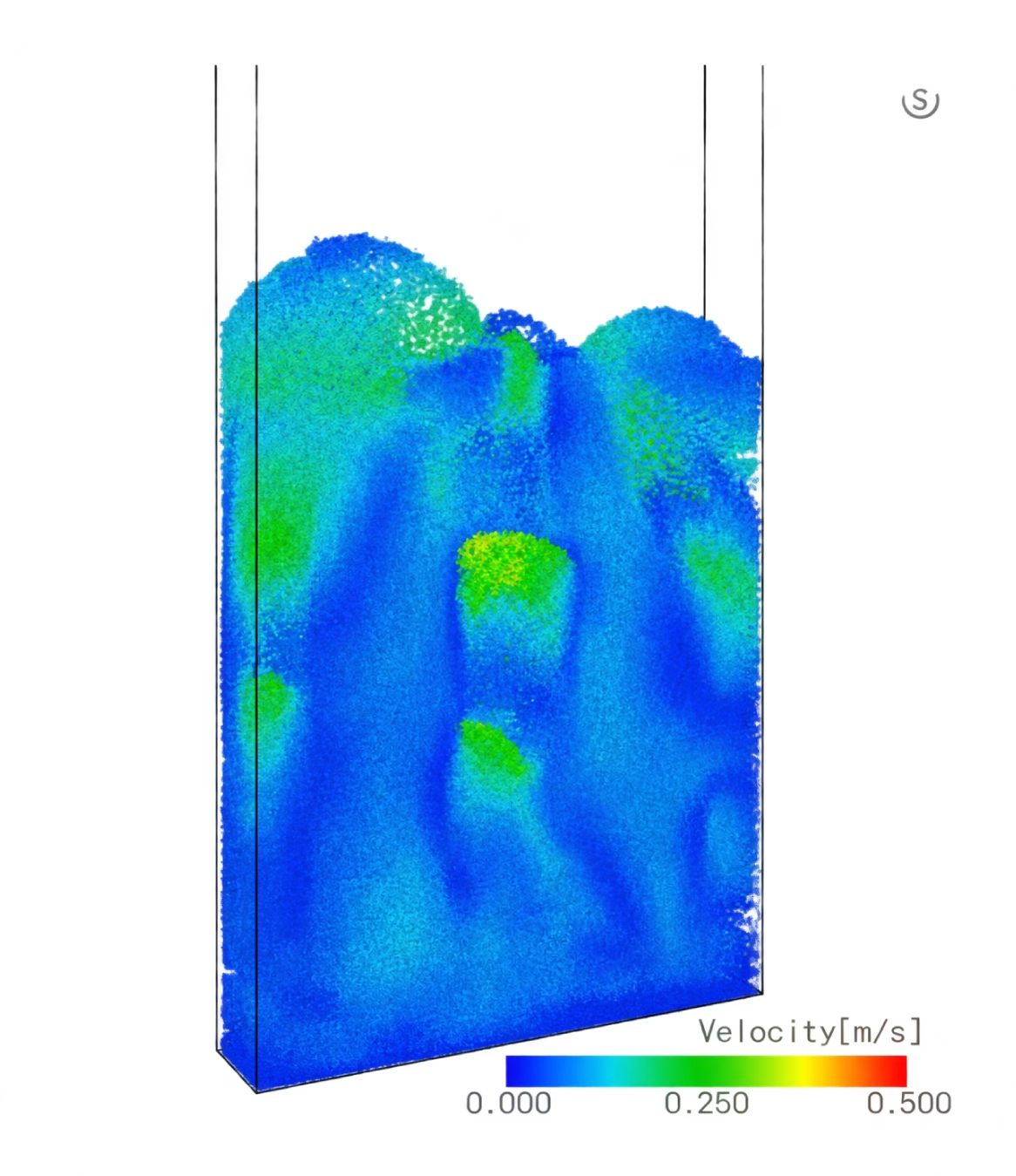
Investigate material discharge patterns, particle accumulation, and potential flow restrictions. Test how geometry, particle properties, and operating conditions affect flow.
WHEN SOLIDS MEET FLUIDS
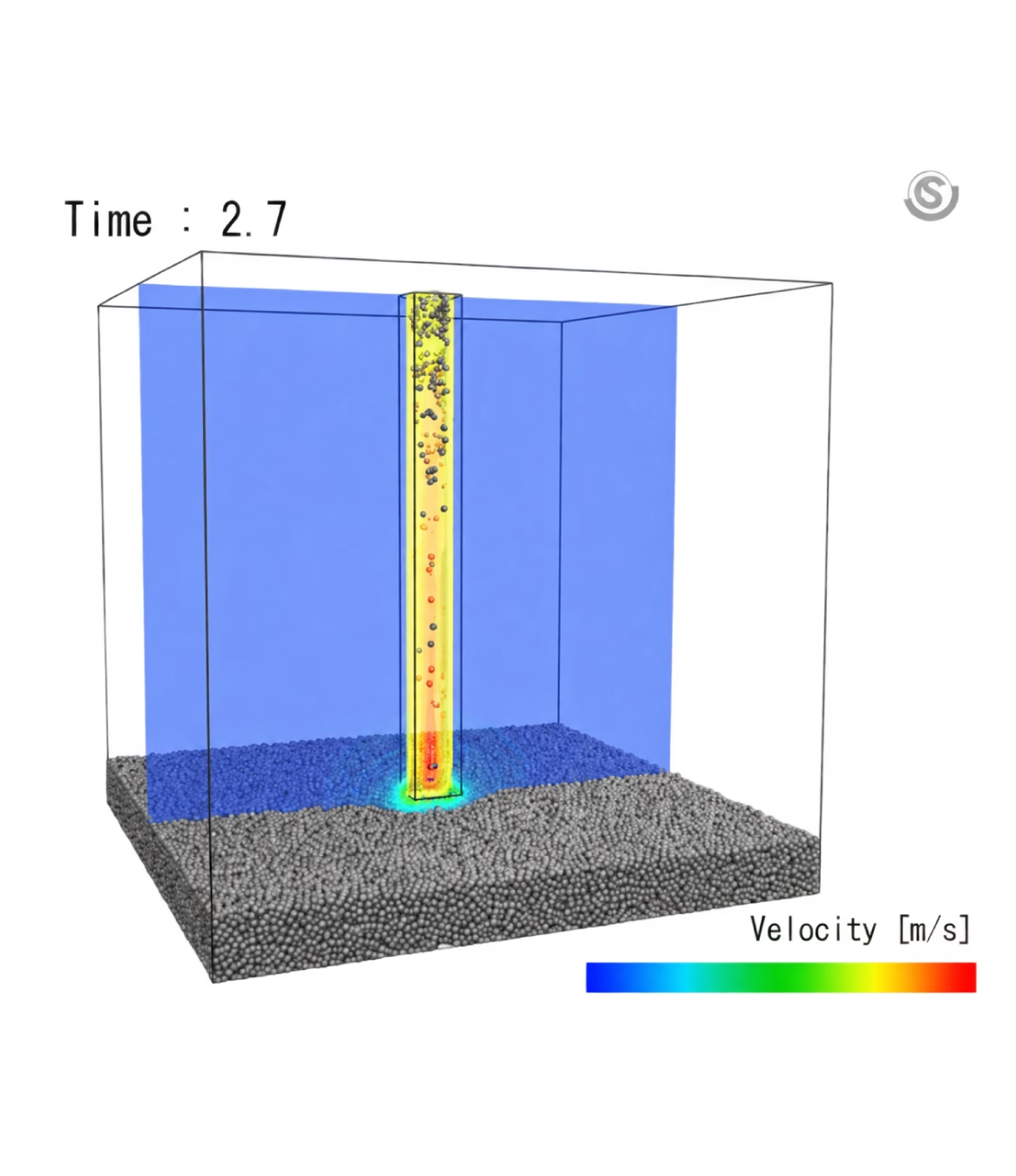
Many industrial processes involve both solid particles and a surrounding fluid. Coupled CFD-DEM simulation resolves particle contact and motion while accounting for the influence of the fluid field.


MORE PHYSICS
Depending on the application and configuration, Cradle's modelling capabilities can extend beyond dry granular flow to more involved physical processes.
MIXING
Examine particle distribution, size-dependent separation, cohesive behaviour and mixing patterns in processing equipment.
THERMAL
Consider suitable particle heat-transfer models, or investigate selected particle dissolution processes involving fluid interaction.
MECHANICS
Study particles within rotating or moving systems, with co-simulation possibilities involving mechanical analysis tools for compatible cases.
WHERE IT ADDS VALUE
Granular-material behaviour influences equipment performance in many industries. DEM provides additional insight into those hard-to-observe interactions.
Rock and ore transport, transfer chutes, hoppers and material accumulation.
Granular mixing, flow restrictions and moving equipment design.
Powders, grains, granules, segregation and particle mixing.
Particle dissolution, sedimentation and selected multiphase processes.
CRADLE CFD
Cradle CFD combines dedicated thermo-fluid simulation tools with particle-related modelling capabilities for appropriate applications.
UNSTRUCTURED CFD
Uses a geometry-conforming polyhedral mesh for fluid-flow applications with complex geometry. DEM functionality can be used for particle-only and coupled CFD-DEM studies.
STRUCTURED CFD
Uses a Cartesian mesh for suitable fluid and thermal problems. DEM functionality is also available.
SIMTEQ Engineering provides software, training, support and engineering simulation services.
COMMON QUESTIONS
START WITH YOUR APPLICATION
Talk to SIMTEQ Engineering about DEM simulation. Cradle CFD capability, training or engineering support.