SIMTEQ Newsletter 2026-Q1

Introduction
Events
Product of the month
News
New releases
Training

A Strong Start to 2026 — Looking Ahead Together

As we move through 2026, it’s clear that this year is already shaping up to be one of momentum, innovation, and meaningful connection. Building on the progress of last year, we’re excited to continue engaging with you through new initiatives, events, and opportunities designed to support your engineering journey.

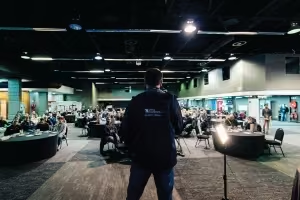
One of the key highlights this year is the SIMTEQ Engineering Users’ Conference, taking place earlier than usual on 17 June 2026—giving you the chance to connect, learn, and gain valuable insights sooner in the year.

We’re also proud to support the next generation of engineers through initiatives like the Cars4Mars African Rover Challenge 2026, where simulation plays a critical role in enabling teams to design, test, and innovate with confidence.

Beyond this, you’ll find SIMTEQ actively participating in major industry events such as Electra Mining Africa (7–11 September) and AAD 2026 (16–20 September)—creating more opportunities for you to engage with our team and explore the latest in simulation technology.

To support continuous learning, we’re expanding access to knowledge through our SIMTEQ Engineering and SIMTEQ Labs YouTube channels, bringing practical insights, technical deep-dives, and innovative applications directly to you.

As technology continues to evolve — especially with the growing impact of AI — one thing remains clear: a strong engineering foundation is more important than ever. That’s why we remain committed to equipping you with the tools, training, and insights needed to stay ahead.

We look forward to what lies ahead and to continuing this journey with you.

Best Regards

Managing Director

SIMTEQ Users' Conference 2026

You’re invited to the SIMTEQ Engineering Users’ Conference 2026, taking place earlier this year.

📅 17 June 2026
📍 CSIR International Convention Centre

Join engineers, simulation users, and industry professionals for a day of practical insights, real-world case studies, and meaningful networking.

Whether you're new to simulation or an experienced analyst, this event is designed to inspire, educate, and connect our engineering community.

Seats are limited — we look forward to welcoming you.

Read More...

Discover Simulation at Electra Mining Africa

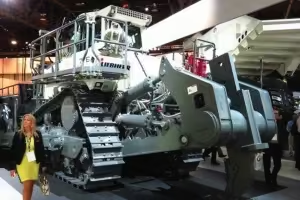
Electra Mining is one of the largest mining, industrial, and technology exhibitions in Southern Africa. Visit the SIMTEQ team to discover how advanced simulation can support smarter design, improved performance, and reduced risk across engineering projects.

We look forward to seeing you there!

📅 7 – 11 September 2026
📍 Johannesburg Expo Centre, Nasrec

Read more...

Advancing Aerospace Innovation at AAD

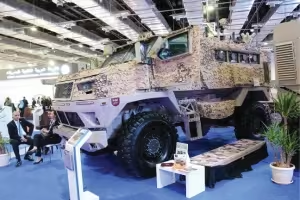
AAD is a premier aerospace and defence exhibition, bringing together global leaders, innovators, and industry professionals. Join us to explore cutting-edge simulation solutions shaping the future of aerospace, defence, and advanced engineering.

We look forward to seeing you there!

✈️ Africa Aerospace & Defence (AAD) 2026
📅 16 – 20 September 2026

Read more...

CAEfatigue

CAEfatigue is a powerful FE-based tool used to conduct durability analyses and it is an industry leader in the frequency domain.
Although CAEfatigue has a comprehensive set of tools to conduct durability analyses in the frequency domain, it also has all the tools to do the same in the time domain but much faster than its competitors.
CAEfatigue can do all the normal S-N, ε-N, spot weld and seam weld durability analyses, the different types of analyses can even be combined into a single analysis if the user requires it.

This however is just the tip of the iceberg in terms of the capabilities that CAEfatigue has to offer and some of the more advanced capabilities are:

  • Time to PSD
  • Random response and collision detection
  • Loads cascading
  • Test design and simplification
  • Surrogate loading
  • Loads tunning
  • Service loads derivation

One of the more recent additions to CAEfatigue that is not mentioned above is Robust Design.

Robust Design

This new technology allows the user to re-run multiple MSC Nastran jobs consecutively while changing the input parameters for each run, the outputs from these runs are used to create a correlation map of input parameters vs. outputs. This shows what effect each of the inputs has on the outputs.

This allows the user to make better design decisions based on a holistic view of how the model reacts under all inputs.

Other interesting additions that are also noteworthy:

Automatic Generation of Load Scenario using Time Histories

Various loading scenarios can be created automatically for a time-domain analysis, instead of having to create the loading scenarios manually.  This automation will prevent errors from occurring and will speed up the analysis setup. 

Multiaxial Stress Assement for Time Histories: 

If the user is unsure which analysis method to use in CAEfatigue because the loading is proportional or disproportional, the new multiaxial assessment capability will allow the user to check the level of multiaxiality in the stress output. Based on the level of multiaxiality the user can decide if standard analysis methods or a more accurate critical plane approach should be used.

Composite Material Outputs from Nastran are Supported:

CAEfatigue can now import the stresses from a Nastran composite material analysis (using PCOMP or PCOMPG entries). This expands the interoperability of CAEfatigue with MSC Nastran output results.

SIMTEQ Engineering WindTunnel

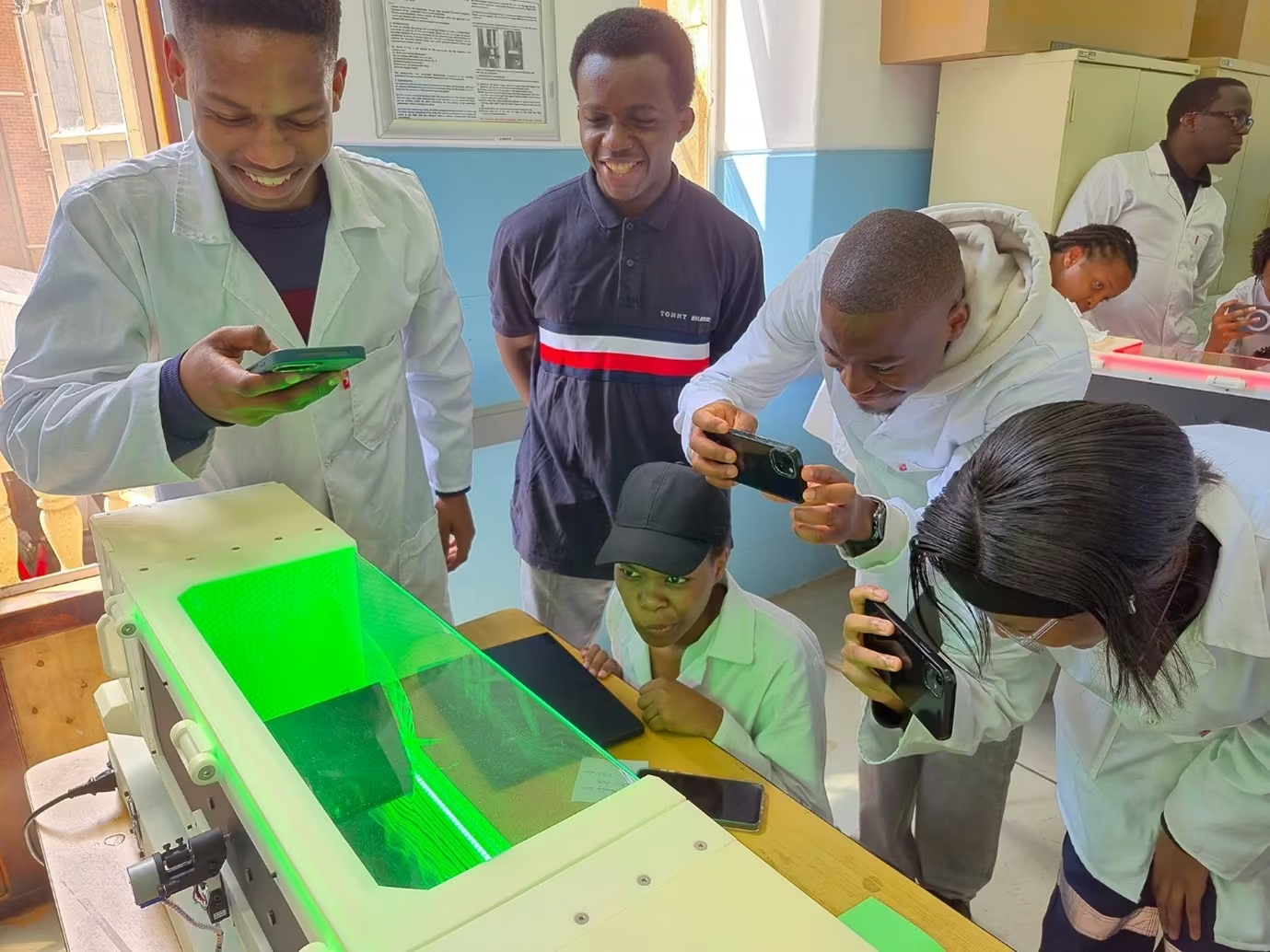
The SIMTEQ VTX-200 Educational Wind Tunnel is making waves at local universities.

Since the delivery of the two wind tunnels to WITS University in January, they have already made a big impact. During one of the practical sessions, Prevani Kistan-Naidoo from WITS University had this to say:

“One of the postgrads who was present said that he wished the tunnels had been there when he did his final-year undergraduate studies, as it would have really helped with understanding certain concepts.” Prevani Kistan-Naidoo, WITS University

Read More...

Subscribe to our SIMTEQ Labs YouTube channel.

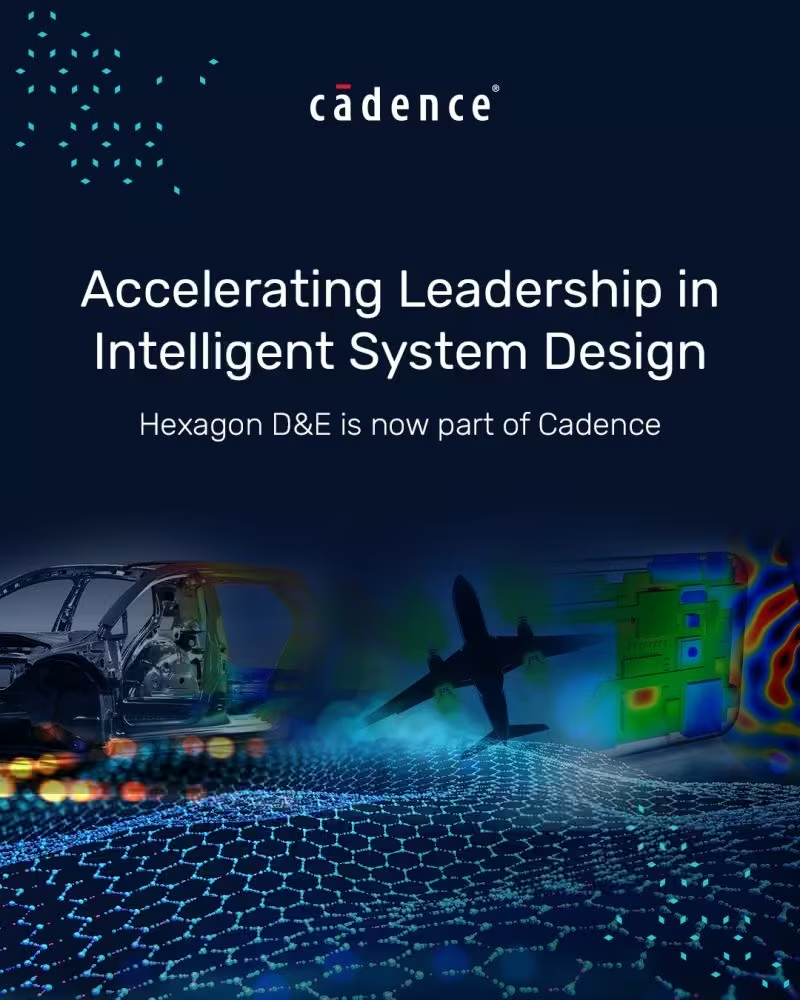
Cadence and MSC Software joins forces

Cadence Completes Acquisition of Hexagon’s Design and Engineering Business, Advancing Leadership in Physical AI and Multiphysics

In a landmark deal completed in February 2026, US-based Cadence Design Systems acquired Hexagon AB’s Design & Engineering business—including the renowned MSC Software portfolio—for approximately €2.7 billion.

​Cadence specialises in Electronic Design Automation (EDA) software, which in practical terms acts like a virtual workshop for engineers: it lets them design, simulate and optimise advanced computer chips and electronic systems on-screen before a single prototype is built, catching errors early and slashing manufacturing costs by billions. Companies like Cadence, Synopsys and Siemens pour intense focus into the EDA space because semiconductors power everything from AI models and smartphones to electric vehicles and data centres. 

​With global chip demand exploding, these high-margin tools have become strategic assets for innovation, supply-chain security and even national competitiveness in the AI era.

Workforce Culture

90%

of Cadence employees are engineers and computer scientists.

R & D Focussed

35%

of Cadence’s revenue is invested in research and development, focusing on its global competitiveness.

R & D Focussed

1988

through the merger of two pioneering companies ECAD and SDA Systems .

Head Quarters

San Jose,
California

For MSC Software, the integration delivers powerful new advantages, combining its flagship CAE tools (such as the structural-analysis solver MSC Nastran and multibody-dynamics leader Adams) with Cadence’s electronics, computational-fluid-dynamics, and AI-driven platforms to create the industry’s first true end-to-end multiphysics simulation environment. Customers in automotive, aerospace and robotics will now run seamless “electronics-to-structure” analyses for autonomous systems and next-generation products, accelerating development while improving accuracy and reliability. This bolsters MSC’s competitive edge in the CAE world against rivals like Ansys, positioning it at the forefront of “Physical AI”—where high-fidelity physics simulations generate the rich data needed to train real-world intelligent machines.

The deal also highlights contrasting investment philosophies: US firms like Cadence embrace aggressive, high-risk growth through rapid investments, venture-capital scale and market-driven innovation, while EU companies like Sweden-based Hexagon traditionally favour measured, long-term strategies focused on steady profitability, sustainability, and core sensor strengths—prompting Hexagon to divest and refocus its portfolio.

For South Africa, the transaction opens doors for local engineers in automotive, mining and aerospace to access more powerful, integrated simulation tools via Cadence’s global ecosystem, potentially speeding up product development and boosting competitiveness for manufacturers already using MSC’s simulation solutions. Geopolitically, the return of a flagship European CAE asset back to American hands reinforces US leadership in the multiphysics and Physical AI race amid rising tensions with China and debates over tech sovereignty in the EU; for an emerging market like South Africa, it means closer alignment with cutting-edge US platforms could bring investment and capability gains, yet it also underscores growing reliance on foreign-controlled critical design technologies in an increasingly polarised global landscape.

Interestingly, Cadence has adopted a subtle, preservation-focused rebranding strategy for MSC Software post-acquisition. Hexagon progressively folded the business into its corporate identity as Hexagon Design and Engineering (Hexagon D&E), downplaying the standalone MSC name in favour of broader portfolio integration. Cadence, however, continues to prominently feature MSC Software as a distinct legacy brand—retaining flagship product names (MSC Nastran, Adams). It will be interesting to see how the acquisition is integrated with existing technologies like ANSA and its CFD technologies.

Ultimately, the combination of Cadence’s advanced EDA and AI-driven simulation capabilities with MSC Software’s industry-leading multiphysics solvers delivers tangible benefits to end users and customers across industries. Engineers and designers gain a single, seamless platform for end-to-end simulation—from chip-level electronics through structural, thermal, fluid, and system dynamics—reducing design iterations, shortening development cycles, and improving first-time-right accuracy. This integrated “electronics-to-physical” workflow is especially powerful for next-generation products like autonomous vehicles, electric aircraft, robotics and AI hardware, where multiphysics interactions are critical. Customers benefit from faster time-to-market, lower development costs, higher product reliability and stronger competitive positioning in an increasingly complex, software-defined world.

Read More...

Cars4Mars

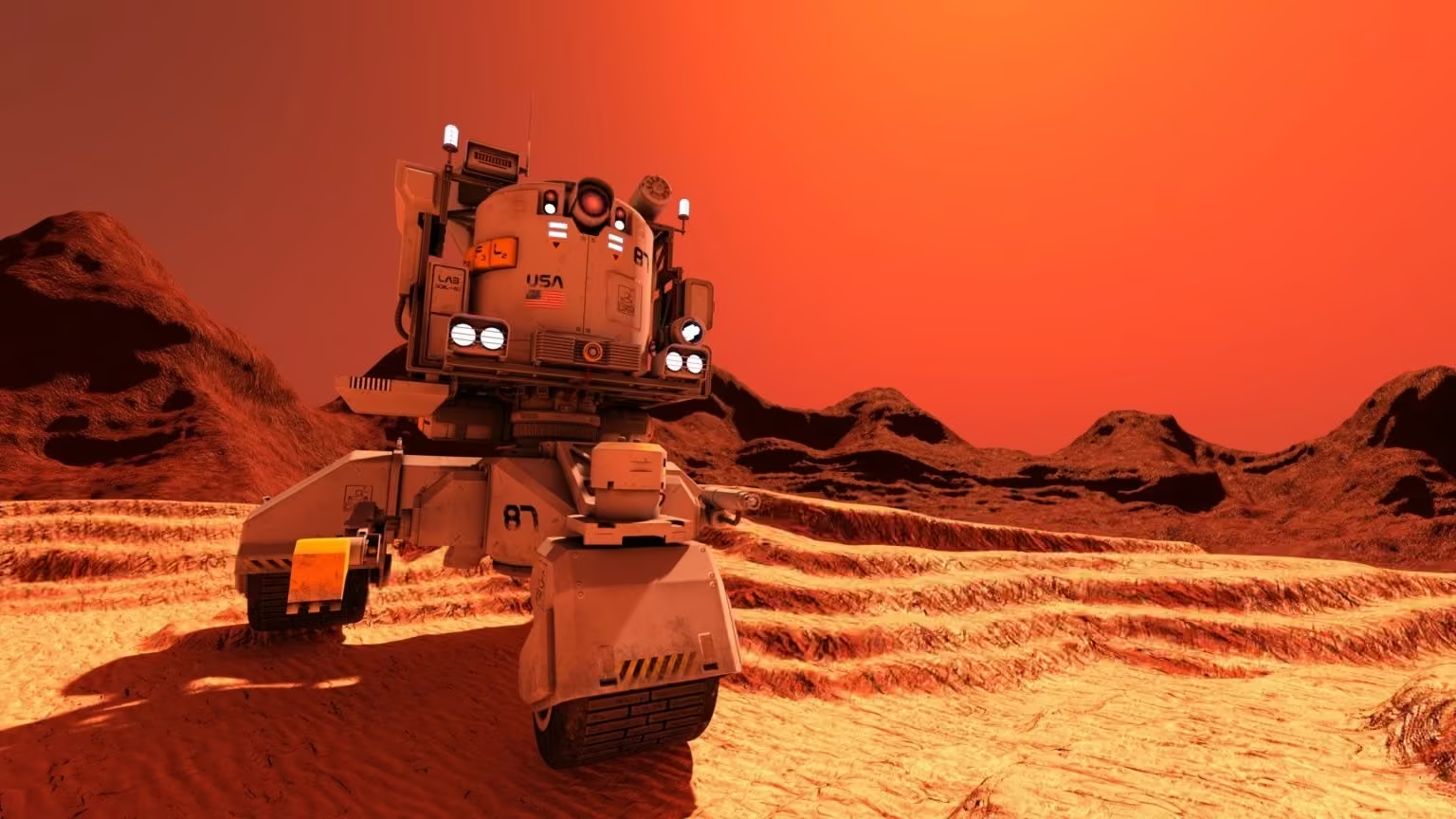
SIMTEQ is proud to be part of the Cars4Mars African Rover Challenge 2026, supporting the next generation of engineers and innovators.

As a sponsor, SIMTEQ is providing simulation software, training, and trophies for both the Launch Stage (Virtual) and the Mars Stage Final, taking place on 19 September 2026 in Johannesburg.

This exciting initiative gives student teams the opportunity to design, test, and refine rover concepts—before ever building them physically.

With access to SIMTEQ’s tools and training, participants can:

  • Simulate rover performance over challenging terrain

  • Validate design concepts before moving into CAD

  • Select optimal electric motors for speed and torque

  • Test and refine control algorithms in a safe virtual environment

By enabling virtual testing and iteration, teams can innovate faster, reduce risk, and build more robust solutions.

📅 Registration closes: 30 April 2026
👉 Learn more and register: www.cars4mars.co.za

We’re excited to see what these future engineers will create.

SIMTEQ Trivia Questions

Stand a chance to win a prize by answering a question in every newsletter this year about SIMTEQ, MSC Software and simulation technology.

Read More...

MSC Apex Generative Design 2025.2.1

MSC Apex Generative Design 2025.2.1 is now available on the Software Download Center.

For support options, please visit our Customer Support site on SimCompanion.

For problems with your login to the SDC, use our Password Finder.

Click Here to update your email communication preferences.

Adams 2025.2.1 Patch

Adams 2025.2.1 is a service pack release that corrects a few issues that early adopters of the Adams 2025.2 release have identified:

  • Slow graphics responses with large shell models
  • Control CAD shell creation via a new default parameter
  • The icon of the spline for Bearing AT deviation should be aligned with the associated label
  • Custom Vertical Axis is not being handled consistently in Adams Car
  • Opening Assembly with Parasolid is much slower in 2025.2 compared to the previous version
  • Model conversion from 2024.2 to 2025.1.1 causes failure in regeneration due to the clip dimension
  • High Frequency Bushing is not declared as thread-safe
  • The Adams Ride plugin is not loaded in the Published cdb containing hydromount bushings
  • Pressing the ‘F1’ key on the Gear AT Spline element can't open the Adams online help for the respective section
  • Can't load simulation results in Adams View 2025.2 while the simulation is ongoing or ended before completion per script
  • Adams Car Parasolid part geometry is sometimes shown under other shell assemblies

Suggested Action:

No action is necessary if you are not impacted by these modifications or if you do not want to take advantage of this update. If instead you wish to update your Adams 2025.2 version, please follow the steps below:

Resources:

This patch is provided as a full product installer and can be deployed independently of the existing Adams 2025.2 installation.

For support options, please visit our Customer Support site on SimCompanion.

For problems with your login to the SDC, use our Password Finder.

Click Here to update your email communication preferences.

Cradle CFD 2025.2

The newest version of Cradle CFD accelerates CFD simulation with a new GPU-native solver, expands capabilities for laser beam welding, and adds new transient 3D-ROM capabilities.

Highlights of This Release:

  • Use scFAST, Cradle CFD’s first GPU-native solver optimised for HPC GPUs for significant simulation speed increases over CPU platforms.
  • Simulate keyhole laser welding, predict penetration profiles, and optimise welding conditions with laser beam welding in scSTREAM.
  • Generate and visualise 3D-ROM files trained on transient datasets and take advantage of new POD interpolation schemes via scripting.

Other product enhancements

  • Improve battery safety with ECM battery parameter identification and a lumped vent model for efficient battery safety analysis.
  • Model preparation is faster and easier with automatic octant mesh refinements and new thin mesh controls.
  • Take more control over post-processing for turbomachinery and gain a better understanding of results with new features for adjusting meridional planes, radial planes, and contours.

Get more details on these and other product enhancements on SimCompanion.

How to get it:

Download Cradle CFD from the Software Download Center.

Resouce:


For support options, please visit our Customer Support site on SimCompanion.

For problems with your login to the SDC, use our Password Finder.

Click Here to update your email communication preferences.

MSC CoSim 2025.2

The newest version of MSC CoSim is now available in the Software Download Center. MSC CoSim 2025.2 brings you powerful enhancements designed to improve accuracy and usability:

  • High-performance nonlinear solver: Use the new high-performance nonlinear solver in MSC Nastran when coupling Adams with MSC Nastran.
  • Region-aware load mapping: Multiple CFD loads from scFLOW can now be mapped to their corresponding regions in FE models for MSC Nastran analysis, ensuring accurate load mapping, even for complex assemblies.

See the full list of new features and learn more on SimCompanion

For support options, please visit our Customer Support site on SimCompanion.

For problems with your login to the SDC, use our Password Finder.

Click Here to update your email communication preferences.

SIMTEQ Engineering Webinar
Contact and Everything That you Need to Know About it
7 October 2022
11:30 - 12:30

Contact and Everything
That you Need to Know About it

Registration
Training

CAEfatigue - Theory and Practical Fatigue Analysis using CAEfatigue

Software Package: CAEfatigue

Price: R  12 780.00/p excl VAT

Date: 21 - 23 April, 2026

Duration: 3 Days

CPD Accredited: No

More Information
Registration

FEA101 - Finite Element Analysis Fundamentals

Software Package: MSC Apex & MSC Nastran

Price: R  21 300.00/p excl VAT

Date: 25-29 May, 2026

Duration: 5 Days

CPD Accredited: 5 Points

More Information
Registration

MAR101&102 - Nonlinear Analysis using Marc and Mentat

Software Package: Marc & Mentat

Price: R  21 300.00/p excl VAT

Date: 22 & 26 June, 2026

Duration: 5 Days

CPD Accredited: 5 Points

More Information
Registration

CAEFatigue—Theory and Practical
Fatigue Analysis using CAEFatigue

Software Package: CAEfatigue

Price: R  12 159.00/p excl VAT

Date: 17 - 19 November, 2025

Duration: 3 Days

CPD Accredited: No

More Information
Registration
Apex CAD Competition

Who’s the best MSC Apex user in South Africa (or the world)?

The MSC Apex User Challenge is underway—and the competition is fierce.

The challenge officially kicked off on 27 February 2026, and Round 1 submissions were due on 16 March.

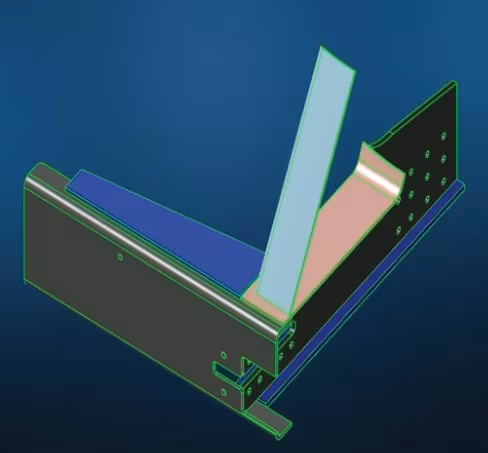
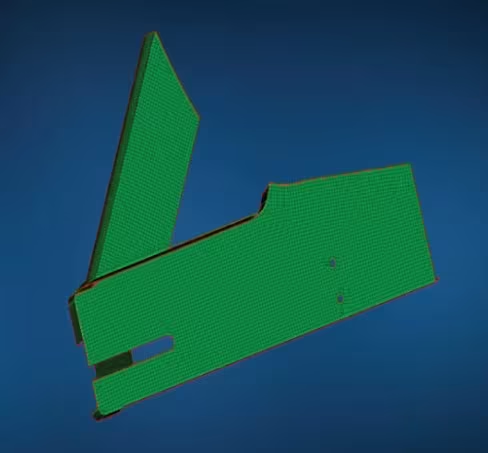
One thing became clear very quickly: our users are true professionals who know their tools inside and out. The current record time to create and prep a mid-surface model—ready for analysis—is under 2 minutes for this seemingly simple structure.

But this is no ordinary, demo-ready model. It dates back to a benchmark we ran in 2014, when we received a manufacturing-ready 3D CAD model with the perfect signature of an analyst’s worst nightmare.

In fact, since 2014, we still haven’t found a single model that showcases quite as many of the CAD issues analysts run into when cleaning geometry and preparing it for Finite Element Analysis. There were so many defects that we dedicated a full article to what we found—and how to fix it in MSC Apex: 18 (Now 20) Real Reasons Why MSC Apex Is My No. 1 CAD Clean-Up Tool of Choice - SIMTEQ Engineering

The challenge runs until 8 June, with 7 rounds in total. Competitors earn points in each round based on how quickly they can prepare the provided model for that stage. After every round, they can see how the front-runners approached the task, pick up a few tricks, and try them in the next round.

The overall winner will take home an Augmented Reality headset worth R10k, and we’ll announce the results at the 2026 SIMTEQ Users’ Conference on 17 June at the CSIR Convention Centre.

Want to follow the action? Log in to this address using any Microsoft account. The front-runner videos are published under the “Shared” tab.

Good luck to all the competitors—see you in Round 2!

Sharpen the Saw OR Lunch & Learn Sessions
starcrossmenulistchevron-down linkedin facebook pinterest youtube rss twitter instagram facebook-blank rss-blank linkedin-blank pinterest youtube twitter instagram